
The EOSC Execution Framework provides composability-based applications to enhance deployment and accessibility of services in
Updated 22/04/2026
EOSC Interoperability Framework Registry Featured in ERCIM News Special Issue on Open Science
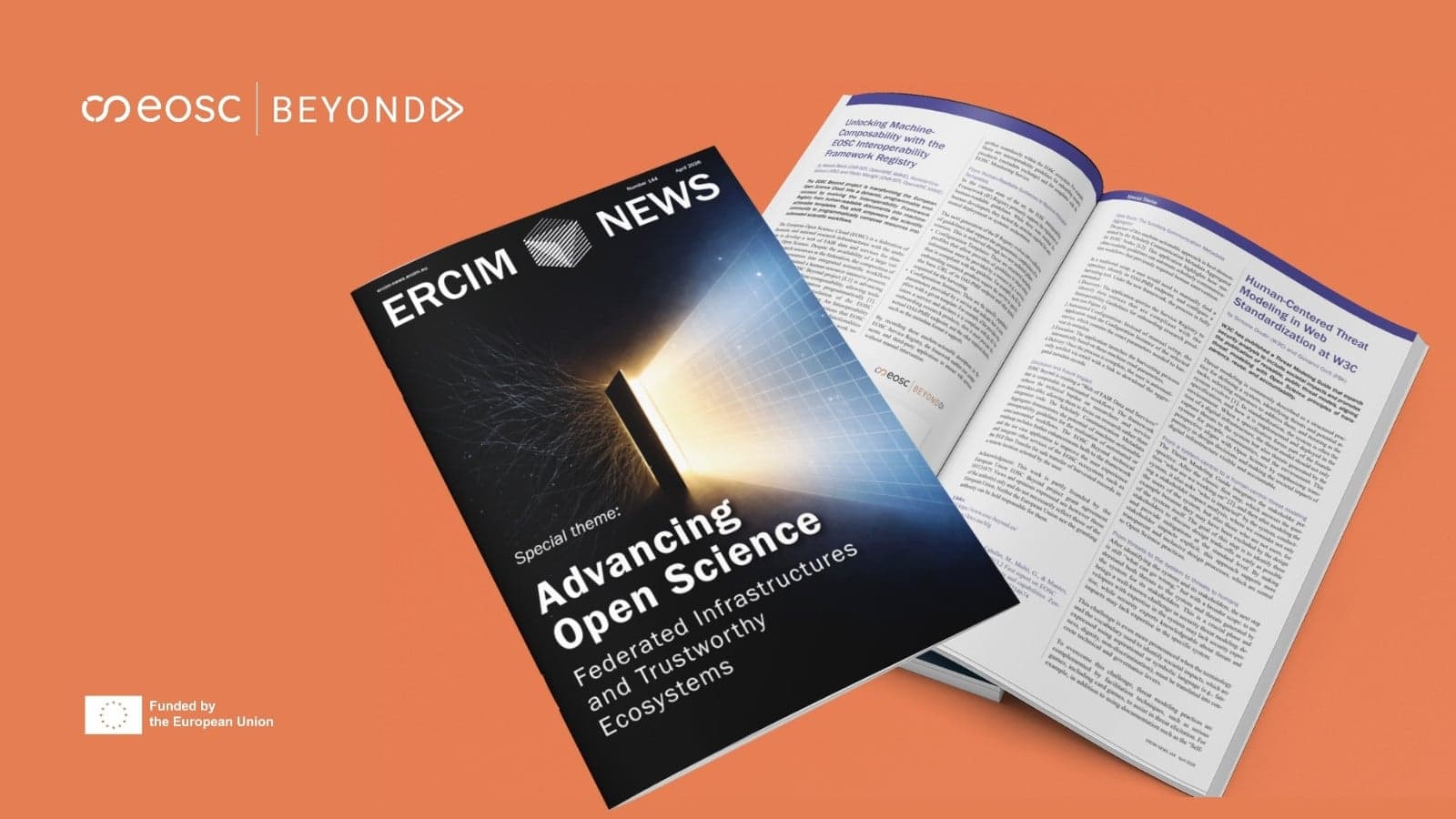
We are pleased to share that an article on the EOSC Core Innovation Sandbox has been published in the April 2026 edition of ERCIM News (Issue 144), as part of the special theme "Open Science Experiences and Prospects."
The article, titled "Unlocking Machine-Composability with the EOSC Interoperability Framework Registry," was authored by Alessia Bardi (CNR-ISTI, OpenAIRE AMKE), Konstantina Galouni (Athena Research Center) and Paolo Manghi (CNR-ISTI, OpenAIRE AMKE) on behalf of the EOSC Beyond project. It presents how the project is transforming the EOSC Interoperability Framework (IF) Registry from a collection of human-readable documents into a system of machine-actionable templates.
About the Special Issue
Guest edited by Leonardo Candela (CNR-ISTI) and Roberto Di Cosmo (Inria and University Paris Cité), the special theme explores the current state of Open Science across Europe. The editors note that while Open Science has become an operational requirement embedded in national strategies and funding conditions, fragmentation remains a key challenge. The issue brings together contributions on federated infrastructures, semantic frameworks, governance, skills, and operational experiences from major European initiatives.
The EOSC Beyond article sits within a cluster of contributions focusing on semantic foundations and knowledge graph infrastructures as critical enablers of interoperability.
About the Article
Our contribution describes how the next generation of the IF Registry supports the programmatic composition of resources through two new technical pillars:
- Configuration Templates: Structured metadata profiles that specify what information a resource must provide to comply with a given interoperability guideline.
- Configuration Instances: The specific parameters provided by a service that indicate how it complies with a given template.
The article demonstrates this evolution through a concrete case study: the Scholarly Communication Metadata Aggregator for EOSC Nodes. This application automatically discovers OAI-PMH compliant data sources, reads their Configuration Instances, and launches metadata harvesting without manual intervention.
Access the Publication
The full ERCIM News Issue 144 is available online:
Related content

EOSC Execution Framework

First release of the EOSC Execution Framework, Automating Research Workflows in the Cloud
The EOSC Execution Framework enables dynamic, automated deployment of services and data staging.
October 06, 2025
Webinar: New Integration and Execution Services in EOSC Beyond
Discover the EOSC Integration Suite and the EOSC Execution Framework
27 November 2025